Friday, April 25, 2025

Proactive Observability: A Strategic Imperative for Scalable Systems

In the fast-paced world of software engineering, system complexity is a constant. Services grow, user demands evolve, and architecture becomes more distributed. Amid all this change, one principle remains vital: clear, continuous observability.

While most teams have some form of monitoring in place, truly resilient, high-performing systems demand more than out-of-the-box dashboards or ad hoc alerts. It’s not about simply having visibility—it’s about having the right visibility at the right time, with actionable insights that drive real decisions.

Let’s explore why proactive observability is not just a technical best practice but a strategic cornerstone for modern engineering.

Seeing the Full Picture

To operate and scale systems effectively, engineering teams must deeply understand how their infrastructure behaves in real time. This starts with asking key questions:

  • Are we aware of how load is distributed across our systems? Without this, it's impossible to plan capacity, predict bottlenecks, or scale with confidence.
  • Do we have fine-grained insights into processing times? These metrics are critical for identifying slow paths and queue buildups that silently erode performance.
  • Are we tracking queue levels at every stage? Queues often reveal what metrics don't: where things are stalling, which services are overwhelmed, and what components are underused.

Surface-level metrics or generic dashboards may offer a sense of control, but they rarely tell the whole story. Observability must evolve with the system, reflecting current architecture, user patterns, and operational risks.

Evolving Dashboards for Dynamic Systems

It’s easy to assume that once dashboards are built, the job is done. In reality, observability is not a one-time project—it’s an ongoing commitment.

Systems are dynamic: new services are introduced, old ones deprecated, usage patterns shift, and infrastructure evolves. As this happens, yesterday’s metrics may become irrelevant or misleading. Dashboards that once offered clarity can quickly become blind spots.

The most effective teams treat their monitoring infrastructure as a living system. They continuously audit what’s being measured, update visualizations, and refine what “normal” looks like. They ask: Are we still seeing what matters most?

Intelligent Alerting: From Noise to Signal

Monitoring without intelligent alerting is like watching the sky for storms without ever checking the radar. By the time something goes wrong, it’s already too late.

But not all alerts are created equal. Smart alerting goes beyond simple thresholds. It considers context, combines related signals, and prioritizes what actually needs attention. Done right, it reduces alert fatigue, prevents critical oversights, and empowers teams to respond quickly—with the right information at hand.

Some key practices include:

  • Defining acceptable thresholds based on system behavior, not arbitrary limits.
  • Implementing multi-level alerting (e.g., warning vs. critical) to avoid constant firefighting.
  • Adding rich context to alerts, such as recent deployment activity or related metric trends.
  • Reviewing and pruning alerts regularly to ensure relevance.

The goal is not to alert on everything—it’s to alert on what matters, when it matters.

Observability as Culture

Ultimately, the most resilient systems come from teams that prioritize observability as a core cultural value. This means:

  • Building observability into the development lifecycle, not treating it as an afterthought.
  • Empowering engineers at all levels to own and refine monitoring for the services they build.
  • Celebrating proactive insights that prevent incidents—not just heroic recoveries when things break.

In this mindset, dashboards and alerts aren’t just tools—they’re strategic enablers. They support better decision-making, faster incident response, and more efficient scaling. They help teams move from reactive firefighting to proactive system stewardship.

Final Thoughts

As systems grow in complexity, the cost of poor visibility compounds. Latency spikes go unnoticed. Bottlenecks persist. Downtime lingers longer than it should.

Investing in robust, evolving observability—through thoughtful dashboards and intelligent alerting—is no longer optional. It’s a strategic imperative for any engineering team that values reliability, scalability, and efficiency.

Let’s make proactive observability a cornerstone of modern engineering.

Tuesday, April 22, 2025

Refactor or Rewrite?

As engineering leaders, we’re often faced with a familiar crossroads: the codebase is showing its age, new features are harder to ship, and technical debt is piling up. The question inevitably arises—should we refactor, or should we rewrite?

The idea of a clean slate can be appealing. Starting from scratch sounds like freedom from the past. But as leaders, it’s our responsibility to think beyond the code and consider the broader impact—on timelines, team morale, product velocity, and business continuity.

Let’s explore both paths with the strategic lens leadership demands.


Refactoring: Evolving What Works

Refactoring is about improving the structure of the code without changing its behavior. It’s incremental, continuous, and safe. Think of it as upgrading the plumbing in a functioning building—you get immediate benefits without shutting the whole operation down.

For engineering teams, refactoring allows:

  • Steady delivery: Your team can ship improvements while the system remains usable.
  • Knowledge retention: You’re building on years of domain context.
  • Lower risk: Fewer regressions, faster testing, and fewer surprises.

Most importantly, every small win delivers value immediately. You fix a naming convention, extract a service, or simplify a function—and the system is better for it that same day.


Rewriting: The High-Risk, High-Cost Option

Rewriting is exactly what it sounds like—starting from scratch. While it promises a pristine architecture and modern tech stack, rewrites defer all value until the very end. Nothing ships until everything’s ready.

That means:

  • Delayed ROI: You don’t benefit until the rewrite is complete. Rewrites take, on average, 2–3x longer than initially estimated (McKinsey Digital, 2021).
  • Business risk: Your current system stagnates while the team focuses on the new one.
  • Increased bug rates: New systems reintroduce old bugs or create new ones. Teams often see 15–25% higher initial defect density in rewritten systems.
  • Team pressure: Rewrites often burn out teams and stall innovation. Morale drops when progress is invisible. One internal survey at a major SaaS company found a 23% increase in dev attrition during an 18-month rewrite project.

And the kicker? A classic adage in software holds true:

“You’re never just rewriting the code—you’re also rewriting every bug, edge case, and undocumented decision made over years.”

If you’re considering a rewrite, be brutally honest about your motivations. If your answer is:

  • “This code isn’t written well.”
  • “I can do a much better job.”
  • “I don’t understand why it’s built this way.”
  • “I want to build it my way.”
  • “I want to create my legacy.”

— then you’re not making a strategic decision. You’re reacting emotionally.


When Is a Rewrite Justified?

There are scenarios where a rewrite is the right choice: when the architecture is fundamentally flawed, the tech stack is obsolete, or the product’s direction has shifted so drastically that the old system no longer fits.

Even then, the decision should be backed by:

  • A clear cost-benefit analysis
  • A realistic delivery timeline
  • A plan to mitigate downtime and knowledge loss
  • A strong business case supported by stakeholders

Without these, a rewrite is a gamble—one that too often ends in missed deadlines, frustrated teams, and technical debt in a different flavor.


The Leadership Perspective

As an engineering leader, your role isn’t to chase technical perfection—it’s to enable sustainable, high-impact progress. Refactoring supports that goal by allowing your team to move fast without breaking things. It gives you a path to improve the system while continuing to deliver value to the business.

Rewriting might feel like bold leadership, but unless it’s backed by data and driven by necessity, it’s often just risky.

Choose evolution over revolution—most of the time, it’s the smarter, more resilient path forward.

Sunday, January 12, 2025

Tough conversations

Tough conversations — even the thought of them can make my heart race. I loathe them. They leave me jittery, shaky, and emotionally overwhelmed.


Recently, I found myself in a situation where I needed to confront someone. There was no major conflict or alarming issue, just subtle, uncomfortable moments — unspoken tension beneath polite exchanges. My usual approach would have been to let it slide, ignore the discomfort, and move on. I even tried convincing myself that addressing it wasn’t necessary. But this time, something shifted. Instead of brushing it under the rug, I chose to speak up.


The conversation didn’t start smoothly. My hands trembled, and my voice revealed my nerves. I’m sure the other person noticed. But as we talked, the tension eased, and the discussion became more grounded. I found the courage to express my feelings and clarify my needs. It wasn’t about winning or losing — tough conversations rarely are. They’re about fostering understanding, setting boundaries, and improving relationships.


For most of my life, I avoided confrontation, rationalizing that staying silent was easier. But lately, I’ve been challenging that instinct. By leaning into these difficult moments, I’m learning to articulate my expectations with honesty and courage. The results have been transformative — greater clarity, mutual understanding, and a stronger foundation for the future.


I have to credit my wife for encouraging me to take this step. Her support gave me the confidence to push through discomfort and make my expectations clear. Tough conversations may never feel easy, but they’re worth it. Moving forward, I’m embracing the discomfort, knowing that growth comes from facing these moments with an open mind and heart.

Saturday, December 21, 2024

Writing and me

have a deep passion for writing and actively explore various styles, ranging from creative and analytical to technical forms. Whether it’s crafting opinions and analyses on significant events or preparing project and design documents, I seize every opportunity to write whenever I can carve out a few minutes. This habit keeps me engaged, reflective, and intentional about the content I consume.

When I first began writing a couple of decades ago, I believed I could articulate my thoughts exactly as I imagined them. It didn’t take long to realize how much I had underestimated the complexity of translating thought into words.


As a high school student, I was introduced to some of the most beautiful poetry by great poets, with John Keats leaving the strongest impression on me. My first encounter with Keats was during my junior year, when we studied La Belle Dame sans Merci as part of our curriculum. I distinctly remember the summer mornings when my English teacher recited and explained the poem, unraveling its language and beauty. At the time, my language skills were far from polished, and I struggled to fully grasp the nuances of Keats’ words. Yet, I fell in love with his work, captivated by the depth and elegance of his poetry.


Accessing books wasn’t easy back then. Public libraries weren’t available, and most of my time was consumed by mastering high school math, physics, and chemistry. Even so, I found a poetic rhythm in solving complex math problems; they felt, in their own way, as enchanting as the verses of a poem.


A couple of years after graduating high school with excellent grades and acing the entrance exam, I embarked on a bachelor’s degree in engineering. During my first couple of years, though I devoted some attention to my studies, I often found myself lost in my thoughts. One major factor that shaped this state of mind was gaining access to a quality library.


My dad had arranged for a membership at the British Library, conveniently located on my route home from university. Some days, I would stop there, drawn to the modest section dedicated to poetry. It was during those visits that I discovered the works of several great poets, and my perspective on the world began to shift. The intricate beauty of language—how words could be woven together to create something imaginary yet deeply expressive—felt like pure magic to me. Poetry became my new math, a subject of endless fascination and exploration.


Oblivious to the world around me, I lost myself in a utopian dream, spending countless hours and days immersed in that imaginary realm. In reality, I lived like a robot, going through the motions, but in my mind’s universe, I was truly thriving. I lost all sense of time, often forgetting the hour or even the day, as I devoted myself to the solace of poetry.


After two years of being completely out of sync with my real world, I’ve come to realize the impact it has had on my future prospects. I always took pride in my ability to grasp ideas or concepts quickly—often on the first read or explanation. Such was my focus. Yet, during those two years, I failed to exercise that strength. I don’t regret the experience itself; I only regret my inability to balance it with the demands of my regular life. Following that realization, I discovered my love for writing code, particularly in the C programming language. I developed a deep fascination for automata theory and language compilers, both of which captivated me with their logic and elegance.


After graduating from the university, I was fortunate to join the research team at TCS, where I took on a pivotal role in maintaining a business language translation system that could generate error-free C++ code from structured language inputs. It was an incredibly rewarding experience that combined my passion for programming with the challenge of solving complex problems.


Drawn by the highly lucrative opportunities in the financial services industry, I transitioned from my fulfilling and intellectually rewarding role at TCS into banking, where I built a progressive career. My work primarily involved crafting comprehensive memos that detailed business, market, and financial analyses, along with well-reasoned justifications for lending or investment decisions.


Life came full circle when I transitioned back into technology, returning to writing code in C++ and eventually advancing to creating technical documents to present ideas for complex projects. This shift reignited my passion for programming and problem-solving while allowing me to combine technical expertise with clear communication.


Throughout my career, I’ve been fortunate to explore diverse avenues for expressing my thoughts and ideas through writing. Whether as an amateur poet capturing emotions, a programmer crafting efficient solutions in C/C++, or a professional drafting detailed memos to support critical financial decisions, writing has been a constant thread—one that has remained both a deeply fulfilling and integral part of my journey.

Monday, December 02, 2024

S&P 500 Vs VIX

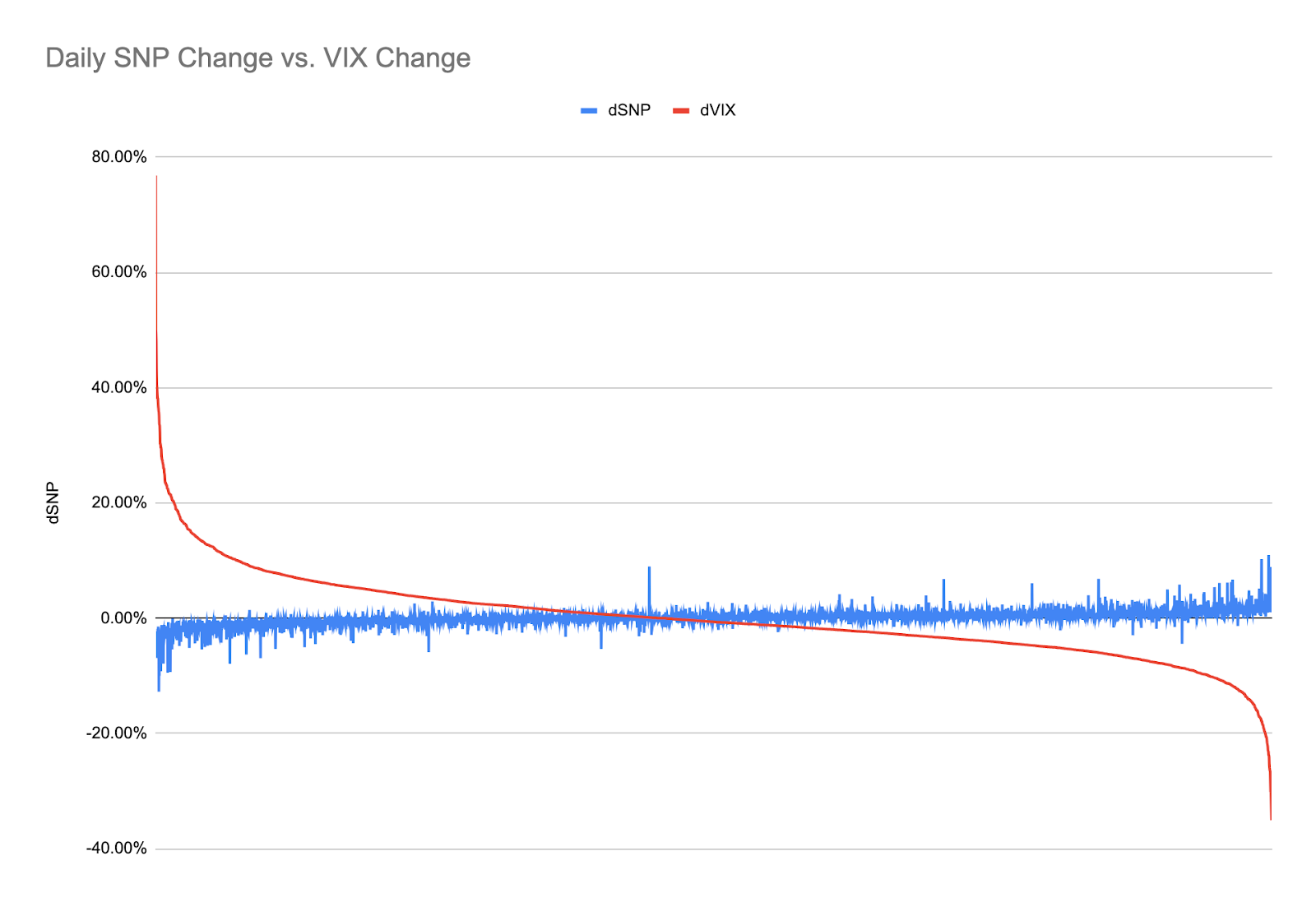
S&P 500's Daily Returns Vs Daily VIX Change.

The daily changes have been plotted by sorting the data from the highest daily increase in VIX to highest daily fall. This plot clearly conveys a high negative correlation between the daily movements of these 2 indices -- as the Fear index (VIX) increases, the S&P 500 index falls.
 

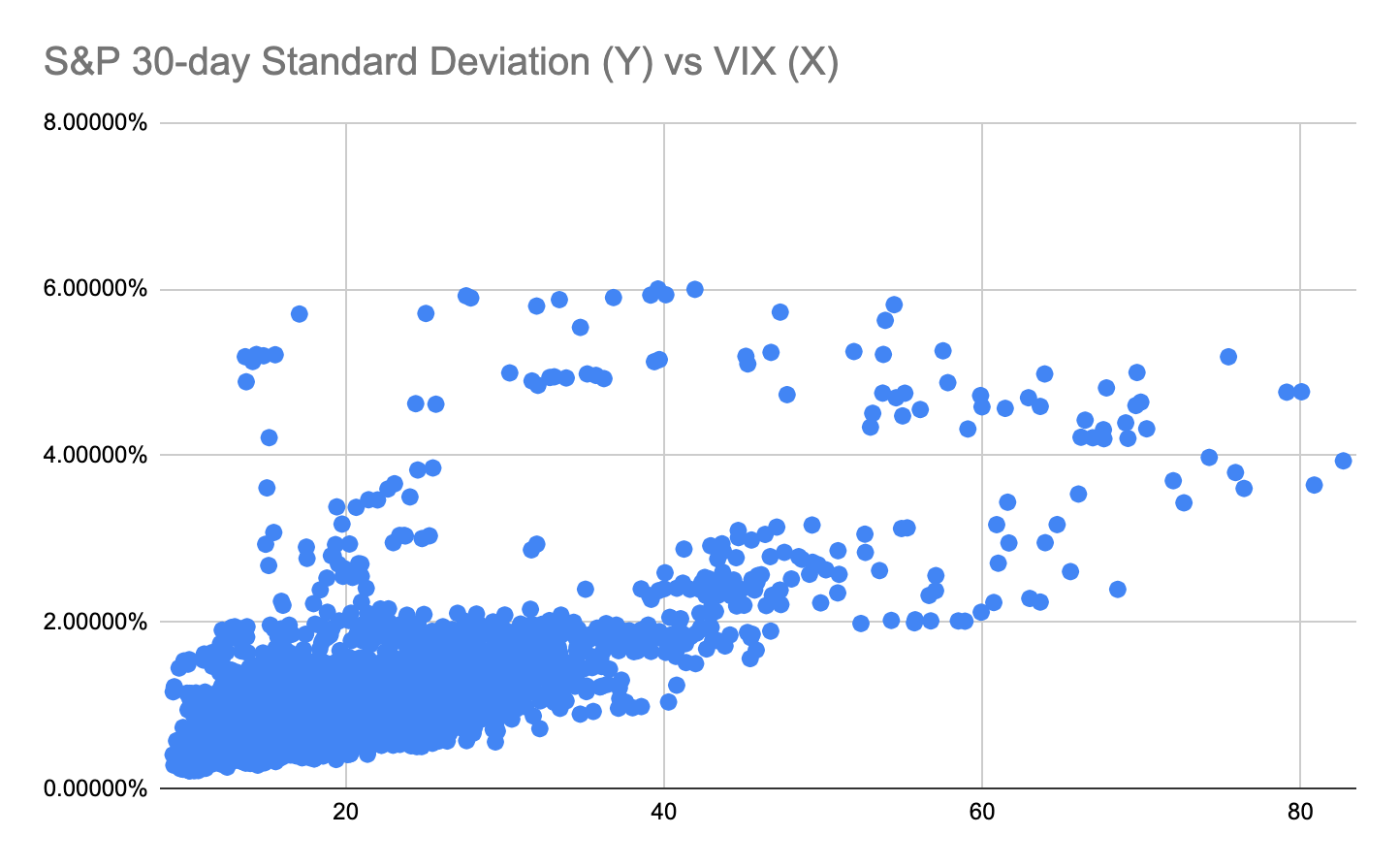
Using VIX to predict S&P Volatility

By definition, VIX is an indication of expected market volatility in the next 30 days. Plotting standard deviation of the 30-day forward S&P standard deviation (Y) against VIX (X) on that day, indicates a decently correlated graph. Correlations between these were found to be 72%. VIX can't explain about a quarter of the volatility we observe in S&P over the next 30-days.
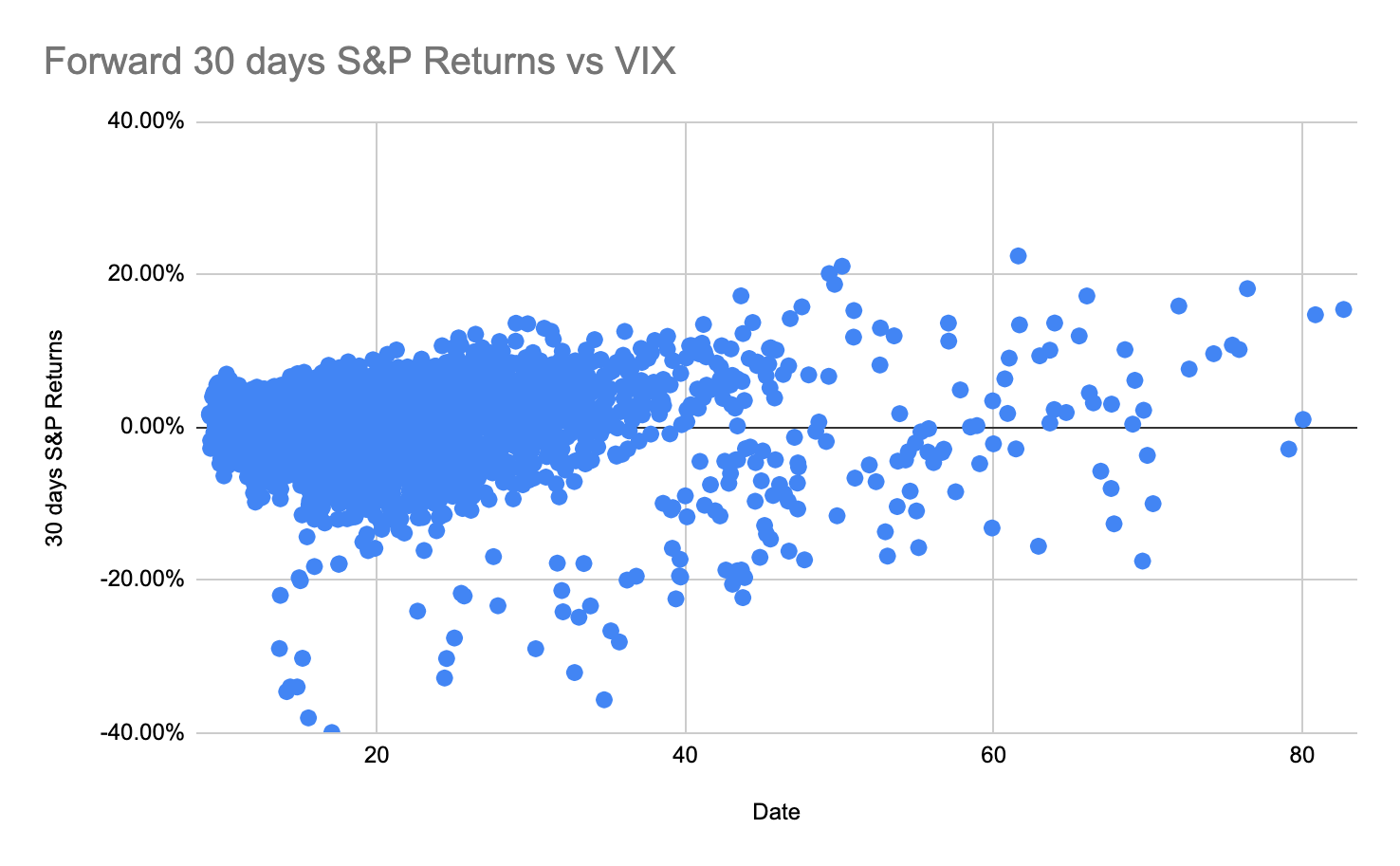
While VIX only indicates expected volatility and doesn't claim to predict S&P returns, I still went ahead and tried to plot 30-day forward S&P returns (Y) against VIX (X). As expected, I found that VIX can only explain about 5.8% of the 30-day forward returns of S&P. The plot indicates a poor correlation.
Analysis was based on daily closing values of VIX and S&P indices from 05-2004 to 11-2024.

Tuesday, November 19, 2024

Five Key Issues for the New Term of President-Elect Donald Trump

The achievements of Mr. Donald Trump, former President and now President-Elect of the United States, stand unparalleled in recent history. His return to power following a significant defeat in the previous election underscores his enduring ability to garner support across a broad spectrum of the American populace—cutting across lines of race, gender, political affiliations, and other divisions.

Both his popular vote and electoral college victories reflect a mandate that few can dispute. With such a strong endorsement, one can hope that his administration will focus on enacting transformative policies, revitalizing lawmaking, and restoring the country’s growth trajectory. In my opinion, there are five key areas that demand urgent attention: healthcare, immigration, taxation, innovation, and international trade.

1. Healthcare Reform

The U.S. healthcare system, while advanced, is deeply flawed. Despite its capability to save lives, it is one of the most inefficient systems globally, plagued by excessive bureaucracy, waste, and misuse of grants. These grants, intended to foster innovation, often fail to translate into meaningful healthcare outcomes for the taxpayers who fund them. The U.S. has historically been a leader in medical innovation, driven by science and rigorous decision-making. However, placing individuals who disregard scientific principles at the helm of healthcare only exacerbates inefficiency and disorder. Reforms must prioritize efficiency, accountability, and the promotion of tangible benefits for American citizens.

2. Immigration Policy

Immigration remains a broken facet of U.S. policy, repeatedly altered by political motives rather than comprehensive strategy. Legal immigration, which contributes to the economy and supports the tax base, should never be deprioritized in favor of leniency toward illegal immigration, which burdens public resources. Such policies contradict the foundational American principle of meritocracy. President Trump’s unconventional approach to governance uniquely positions him to address these challenges decisively and craft a fair, effective immigration system that aligns with national interests.

3. Taxation and Fiscal Responsibility

The inefficiencies in various government agencies and departments result in a significant waste of taxpayers’ money. Misallocated grants and unwarranted subsidies not only drain public funds but also encourage a culture of dependency and inefficiency. Addressing these issues would allow for a reduction in the tax burden on citizens and businesses, while simultaneously reducing national debt. A leaner, more efficient system can redirect resources toward productive uses and ensure that taxpayer contributions support meaningful and sustainable initiatives.

4. Promoting Innovation

Declining research and development (R&D) incentives since 2017 have dampened U.S. competitiveness in innovation. By reinstating robust incentives for R&D, the administration can reverse this trend and restore America’s position as a global leader in technological and scientific breakthroughs. This requires strategic policy adjustments to balance taxation and foster an environment where innovation can thrive without excessive bureaucratic hurdles.

5. International Trade Policy

President Trump’s firm stance on international trade has been a polarizing issue, but some of his measures are necessary to protect national interests. While outsourcing to low-cost countries may reduce consumer prices, it often comes at the cost of domestic employment opportunities. For outsourcing to benefit the economy, it must be accompanied by the creation of equivalent high-value jobs and accessible skill-transition pathways for displaced workers. Additionally, anti-dumping tariffs should be implemented judiciously to ensure fair trade practices without disproportionately harming domestic industries or consumers.

A Call for Strategic Leadership

With this new mandate, it is crucial for President-Elect Donald Trump to assemble a team of capable bureaucrats and advisors to address these pressing issues effectively. By focusing on these five areas, his administration can steer the country back toward a path of meritocracy, efficiency, and sustainable growth.

The next term offers an opportunity to enact policies that will not only address immediate challenges but also lay the foundation for a prosperous future.

Saturday, May 16, 2015

For Richer Experiences, Never Quit!

I vaguely recollect the feeling or the emotional state we were in on that day. However, I could recollect a few key things effortlessly. It was more than 8 years back. We had yet another hectic week at IIM-K. We all had rushed to complete project reports, which took a few night outs to complete. We were planning for the last few classroom sessions, which invariably required making a presentation by our team. In most of the cases, I was to present the case in the last session of the class. For those unaware, all the teams (that had not already presented in the previous sessions) had to be ready with the presentations. Therefore, my team had to prepare presentation for all the cases and get to present the last case to the class. My professors either felt that I was the most capable so gave me the last presentation, which typically involves most of the concepts covers in the entire subject, or felt that I am the weakest and wanted me to prepare the presentation for all the topics! I would love to think it was the former. Further, we had to prepare ourselves for the final exams. That trimester, there was a “wow-feeling” and a “phew-feeling”, because, we had (based on our electives) a few days with multiple exams and a gap of 3 days with no exams in between.

That being our last trimester, I was in no mood to prepare for my exams. Yes, that was the time by when I already had a job offer and was complacent. Luckily, I was able to find a few more of my sort in the A-Top (the top floor of the A hostel). We had a crazy idea of planning one last trek before we left the school. A couple of my friends (Alok and Debu) and I planned for a simple trek – we did not want to be too adventurous in between our exams. While it was a very simple one, it was a very good place to go. Hence, we decided to bike to the base camp early morning, finish the trek in 4 hours and come back by late afternoon. We carried enough stuff to last until the lunch.

Everything was as planned until we reached the spot and we started. After about a few 100 m into the trek, we saw a watchtower nearby and went there. After enjoying the awesome view, we went back to the trek. It is from here that we got lost! We realized that after about 500 m and we thought it would connect to the right path and continued for another 1,000 m. Then we thought a bit and decided that we will not go back, even if we have to climb the mountain, we did not have any gear though! We thought we have come for an experience so it does not matter if we do the trek or not, as long as we have the experience. We went forward until we reached the foot of a hillock. We decide to go up that hillock. We used the mountain grass that grew on the hill as support and climbed our way through. It was really a very tough trek! Mountain grass blades are very sharp; we had many cuts on the palms and entire forearms. However, our focus was on surmounting the hillock! The mountain grass generally has very strong roots; that helped us!

After about an hour of such ordeal, we finally could see the normal path. Nevertheless, we could not understand how our route would connect to it. We did not lose hope! We just went further, but this time, sideways, as there was no more grass upwards, it was only a rock. Luckily, after about another 30 minutes of trek, we could reach the way that connected to the correct path. We finally concluded the trek; of course, we took about two extra hours. Did that really matter? NO! It actually was the best trek we ever had. Apart from adding another one to our list of conquered treks, we experienced a tougher trek – climbing almost 75 degrees incline, we could see the base of the hillock when finding the next place to keep our feet. Among the three of us, I rate myself the weakest who would have quit if not for Debu and Alok pushing me.

This experience taught me that if we are determined, we could surmount all the difficulties and achieve our goals. Being at it is all that really matters! In our daily life, we cannot avoid problems nor can we go back to a time from when it would have been easier to tackle. All that matters in such situation is being at it and not quitting. I always tell myself, quitting is the easiest thing and if we quit we would miss many good experiences that would shape our mental being and make us a stronger individual.

I am, because of that experience and not quitting, a stronger person and have been able to face many adversities in both my personal and professional front. I thank my friends who shared the same crazy feeling of doing the trek between the exams, pushing me and supporting me during that experience.

Friday, May 01, 2015

Taking charge of charging into your own hands

With the technology moving so fast, especially getting close to the nanotechnology, I was wondering about 3 years back. Incidentally, I had a discussion with one of my friends as well on this. While I cannot recollect exactly who now, because I generally am freelance on my discussions about innovation/ technology with my friends and colleagues, but I am sure it was a very typical discussion. What is typical here? Yes! I was just about to address that. After most of my discussions on that front, I leave with a feeling that my interlocutor thinks I am stupid. Of course, as one great person said all new ideas were thought to be stupid initially. But, here we are, already challenging our imagination!

Ok! I agree, it is time I got to the point now. It was about charging the mobile phone wirelessly. This is now a reality. Samsung has shown it to the world in its new release. Of course this was not quite the way I imagined it should be. I wanted it to take the charge without it being placed physically on a particular object. Yes! I imagined it to be purely the way we now have the wireless connectivity now. I know that could be a bit too much. But yes there is energy everywhere, the quantum and the intensity varies. But, why can’t we harness this energy to charge our phones? In that direction, I also felt, we can try another way. When we hold the mobile in our hands, why can’t it draw the energy from our body to charge itself, weird? No way! We are a great source of energy ourselves. We have enough static energy on us to burn out a microprocessor or a PCB (Printed Circuit Board). We are also having enough electricity running in our body! You know, I think most of you would know, our heart works with electricity.

So, we know what we should expect in our next wave of technology innovation for the mobile phones. No need to charge our mobile any more, just holding it in our palms should do it! Let us see, who will get there, Apple or Samsung!

Friday, March 13, 2015

Analysis of Unio Budget - 2015

I am a bit late this. However, I thought I should not miss writing it. While most of the people would have done some internet searching to know how the Union Budget for the coming year is going to affect them. So, I will restrict my views to the points I highlighted on my previous entry that was posted on the night before the “Union Budget”. I had covered some broad themes that the Budget should look at from the long-term perspective. Let us know evaluate what the government has announced on those aspects.

GST: As I mentioned, government couldn’t have announced implementation of this immediately as the state governments weren’t taken on board. However, the government has clearly announced its plan to start implementation from the next year (2016-17) onwards, which I believe is the right thing. This will help rationalize the country’s tax structure and bring in more predictability to any investor. It will also ensure that there is greater accuracy in tax collection. However, as the devil resides in the details, knowing the implementation details would help us understand exact level of benefits that we can expect from this. The first problem is the entire structure is similar to the existing. Proposed way of implementing is not going to get us all to a uniform tax regime anytime soon. GST is divided into multiple forms (CGST, SGST and IGST) clearly make it similar to multiple taxation structure prevalent today, VAT, CST and Central/ Service Tax structure. What is new? Nothing!

GAAR: As I said, the government has been acting weak on this. It continues to be so and defers it again. While it isn’t wrong to defer it. But this time, they should backtrack or defer again. I hope that they will not in the next budget. We can only wait and watch.

Black Money: There are many steps proposed on reducing the Black Money problem. There are many penalties and disincentives for those who do not disclose their black money and who have undisclosed foreign assets. This is definitely as way forward. Implementation is what we want to see, as there were already penalties/ punishments for possessing black money!

Subsidies: It is good that there is no significant increase in the subsidy amounts this year’s announcement. However, there have been no steps announced to bring in rationality to the current subsidy structure. That is a disappointment!

Improve Savings: Announcement of special tax saving pension related savings (80CCD for INR 50,000 per month) is a good step towards inculcating a retirement planning approach to individual savings.

Capital Investment and Infrastructure: There is something to cheer on this front by committing huge investments in road, port and energy. Tax-free bonds to fund the infrastructure are coming back. This will also improve the nation’s savings rate.

Export encouragement: Not enough has been provided for the benefit of exporters. Very minimal additional support at this juncture is not encouraging, especially when we are having a gradually increasing import bill. As we can’t reduce dependence on the crude, focus should be on improving exports and reducing import of unnecessary goods (especially those that can be manufactured here). However, there isn’t much to cheer on this front in this budget.

Reduce import dependence: Import restrictions on Gold would partially reduce the import bill. However, the key problem of crude is yet to be resolved. Crude is at the lowest price so it would help us. However, it will not continue at this level forever!

Food and Agri Businesses: Good sums have been allocated towards improving Agriculture infrastructure (25,000 crs for rural infrastructure development fund). But key issues are availability of power, development of cold chain infrastructure. Whether these investments and investments in infrastructure translate into improvement in power and agri supply chain is to be seen.

Summarily it wasn’t a bad budget but at the same time it isn’t a very good one either! Obviously the budget couldn’t fulfil all the expectation. But there is only limited that any government can do. I think within that realm of thought, it looks that the government (Mr. Arun Jaitley) hasn’t disappointed many.

Friday, February 27, 2015

The second most awaited event of the decade - The Union Budget 2015

When I was publishing the previous post, I realized that the largest democracy of the world is going to witness a very important event of the year – The Union Budget.

In May-2014, the world witnessed a historic event happening in India. After almost 3 decades, Indian people have given a clear mandate to a single party. The budget presented post the mandate was more like an interim budget as it was presented in June and the new government was yet to gain a proper understanding. Now, the budget being presented today (when I started writing this, it was 27-Feb-2014, so tomorrow was right; by the time I published, today is right) is a much anticipated event, not only by the Indian citizens but also by the international economies.

Seriously, everyone has a lot of focus on this budget and has many expectations from it. I feel, whenever there is too much of expectation, there is bound to be disappointment. So, don’t be surprised if the budget doesn’t meet your expectations. You are to be blamed! If you had toned down your expectations, you would be in for pleasant surprises. Failing which, you could be in for a rude shock! Having said that, I would like to summarize what this budget should ideally focus on.

GST: This indeed is important. Coal block auction and allocations of certain proceeds from this to state governments is a good way to win over them. It indeed is a step forward in implementing GST. Although this may actually be unimportant in the larger scheme of things, this one act has very far-reaching consequences that every investor would gain more confidence in the economy.

GAAR: Government has been acting weak on this. They have suddenly woken up about 3 years back and went back to sleep. It is tough on the investors but it is needed. No investor can take the country for granted. They can’t avoid tax deliberately and yet not pay penalties. Therefore, government should give some clarity on this. It may not be important that we do it in this year. However, it should give some commentary on its plan to implement this. This has to be consistently maintained and thus prepare the investors. It should also categorically state that this would not be applicable retrospectively.

Black Money: Some tough stands can be taken on this! But, is it not good to say now that “no action would be taken and a flat 25% or 20% or some such level would be levied”. Also, the government should, for the safety and the interest of the public give strong assurance that the names of the people disclosing and paying the tax wouldn’t be disclosed. This way the government would get some additional tax and it would reduce the black money in the system.

Subsidies: There are too many varieties of subsidies. It is simple that the subsidies are aimed at supporting the poor or the underprivileged. In such a case, improving the Direct Benefit Transfer (DBT) system by strengthening Aadhaar mechanism would be a very good idea. Petrol/ Diesel/ LPG subsidy should be withdrawn. This is the right time, as the current Crude and Natural Gas prices are low. So, government should make announcement in this budget to reduce the subsidy levels.

Improve Savings: Lately the savings percentage has been reducing. This could be a combination of two aspects, trend of greater consumption (reduced savings) and high inflation eating into the savings. To encourage savings, as all developed economies should have higher savings rate, government should tweak the tax structure on the earnings on the savings. As most of the bank savings are short term in nature, if some tax benefits are offered to those placing deposits (retail or corporates, it doesn’t matter) for more than 10 years, it would improve banks asset liability mismatches. This would help the banks to participate more vigorously in supporting the infrastructure growth required for the economic growth.

Capital Investment and Infrastructure: As the economy is struggling and as the private players are waiting to make investments in capacity expansion, government should address this by announcing large investments plans, the bet would be in the infrastructure domain. While this may result in crowding out the private investment, but where is the private investment now? It is already at the lows. We rank low on per capita roads, per capita power consumption, most of our villages still live in the dark without access to electricity. Even though we are the 3rd largest in coal resources, we don’t extract it enough. We have good scope to invest in green energies (Solar, Wind, etc.) as well. There should be incentives to infrastructure players in these critical areas. One way would be to reduce the capital requirements on the bank loans to these sectors.

Export encouragement: As we rank badly on the current account scene, the government should encourage investors and entrepreneurs to enter into export oriented businesses to improve our foreign currency reserves. To this effect, there should be some announcements made.

Reduce import dependence: Increase the import of those products that are available and can be manufactured in India. Put some tax savings scheme for those who invest in gold ETFs or such instruments which would reduce the purchase of physical gold. While this would reduce tax inflow, it would also reduce Foreign Exchange outgo. Striking some balance here would be a good idea. Mobiles are soon becoming a large component in the import basket. Give some tax sops to the Indian electronics manufacturers and increase import duty on import of electronic goods. This would also encourage foreign manufacturers to set up manufacturing facilities in India, thereby generating employment.

Food and Agri Businesses: The Farmer is the most ignored person in almost all the budgets. While the corporate do all the financial engineering to get the benefits of F&A policies, the most important person in this value chain is often left wanting. While MSP and Kisan Credit Cards are good policies, there are just the basics. There is a greater need to improve cold storage/ food supply chain. Government should continue existing and announce some more good policies in this direction.

There is a lot more the budget should focus on, too many things that need fixing. But, most importantly, this budget should show clearly that there is a long-term design to the announcements being made in this 2015 budget.

Psychology - Right the reads

Yes, habits do lead to success or failure!

Psychology is the scientific study of the human mind and its functions, especially those affecting behaviour in a given context. So, I always felt that if I can understand this science, I would know why some people behave in a particular way and how we can influence them.

With this as my motivation, I started reading certain types of Psychology books. While these books are not pure theory on Psychology, they can be termed as books on the application part of it. In this direction, I read the book Thinking, Fast and Slow (Author: Daniel Kahneman, Publisher: Farrar, Straus and Giroux). When I read this book, I realized that it is one of the best books on how we think and act. This book introduced me to the concept that humans have two systems, the one that acts fast (this is what we could call as the ‘gut feel’) and the one that is slow and very effort-intensive (rational part/ reasoning part/ the higher order part). This book gave numerous example about how we tend to act unknowingly. How on certain occasions, we move from System 1 to System 2. When we are driving on a highway with no traffic, we are mostly on System 1 and we don’t find it difficult to converse with the co-passengers. However, when we are going in city traffic, we would use more of System 2 and during those times, we don’t actually pay attention to the co-passengers. We tend to remember certain experiences as more painful and certain other equally painful ones as less painful. Shouldn’t there be some reason for that odd behaviour? Yes, it depends on how the experience ended (less/ more painful). For more details, read the book. While it is a bulky one (pages: 499), it is filled not only with theories but also with examples and stories, making it an easy read.

Subsequently, I read the book Nudge: Improving Decisions about Health, Wealth, and Happiness (Authors: Richard H. Thaler and Cass R. Sunstein, Publisher: Yale University Press) this actually dealt on a similar subject as the above one. It dealt more on how we can influence people’s choices. One amazing example I can recollect now is, how reducing the distance between each white stripe on the road will NUDGE the driver to reduce his vehicle’s speed. This book deals with such simple NUDGES that can be used to influence people’s actions/ choices. The book also cautions that these ideas can be misused!

The most recent read in this filed was The Power of Habit: Why We Do What We Do in Life and Business (Author: Charles Duhigg, Publisher: Random House). This book, I would say, has a different style of narration. It has all elements of a movie, editing, suspense, building up of a thrilling climax, etc. Probably because, the author is a Journalist and not a subject expert, it looks different. This doesn’t mean the previous books are any bad reads! They are equally gripping. This book gives multiple examples of successful and failed people, organizations. It also talks about how a habit forms and how one can break bad or unwanted habits.

I think these three books talk about the same things about a human, the higher order self (System 2) and the lower order self (System 1). We often hear that “the habits are deep rooted”, “bad habits die hard”, etc. It is true, they are deep rooted literally too; they sit in our basal ganglia (the central part of the brain). Call it the System 1 or the basal ganglia it is the core part of our brain. A few million years ago, we (rather the species from which we evolved) had only this part. Gradually, as we started doing more complex things (due to the complex environment that evolved around our), these brains developed cortex, which is where the higher order self (System 2) resides. It has been a truly edifying experience reading these books.

Being aware of these things would not only help us improve our awareness of our involuntary actions and reactions but also help us change such reactions, wherever deemed necessary. The next one I plan to read in this direction is Strangers to Ourselves: Discovering the Adaptive Unconscious (Author: Timothy D. Wilson, Publisher: Harvard University Press).

I am reading these books to develop a deeper understanding of human psychology that would help me be a better banker, engineer, innovator and businessperson. Instead of asking "when would you read these books", I now ask "why would you read these books?"

Sunday, February 22, 2015

Have I become a movie buff?

Of late, I have been watching too many movies. Was that 15 in the last 3 months? Something close, if not exactly 15. In reality, my count hasn't ever crossed 5 per year. However, this time it was too high for my standards. What, 60 per year at this rate! I don't think so. Even if I do want to see so many, there should be that many good movies released! On this front (making good movies), I tend to appreciate the movies made by the American's (to some extent the English).
Agreed, some might say my universe (or sample in other words) is too small! I only understand Telugu, Hindi and English. Hence, any movie in Telugu or Hindi is by an Indian. Those made outside and those that I watch are only English movies. Therefore, it is but natural that the Americans or the British made those movies. What is so much to compare? For those who love evaluating various aspects of an argument, here goes another element (apart from language), time span - the movies I watched were made during the last 30 or 40 years. Hey, that was not deduced from my age; one can watch movies made before one's birth!
OK. Why did I conclude that certain people make better movies? I could probably enumerate many technically appropriate reasons, but one thing that beats all is the result - how many of the movies I watched were English (American/ British)? Yes, the strongest reason why I made that conclusion was, two (if not more) out of every three movies I watched are English. I believe this proportion is only going to get more favorable towards the English movies.
Now, let me try to give you some of the technical reasons for my proclivity to the English movies. After all, that is what we would love to discuss and hear!
1. These movies tend to have some uniqueness in their story line or the way the story is narrated.
2. Amazing literature that forms the basis for these movies (Lord of the Rings, Pirates of the Caribbean)
3. The performers don't act, they tend to live in those roles/ characters -- making the movie appear real -- credit also goes to the directors and their commitment to make movies look real.
4. Use of technology that makes the created scenes look real on the screen
5. Budget? Of course, that is what makes it possible to make such huge investments to achieve the quality.
As I have been focusing more and more on the movies, styles of making movies (in India or otherwise), styles of directors and actors, because I have started watching more movies, I would be able to add more details to the list, along with more examples.

Saturday, June 30, 2012

Rationality in Children

I was surprised to learn that in reality, little children are far more intelligent that we would like to accept or believe. I recently understood that when we try to make a judgement about children and their abilities, we are usually far away from reality than we actually think. Then I felt that this could be an interesting enough topic to post on my Blog. The first thing that made me realize of my incorrect opinion on the rationality and cognitive abilities of children was their sense of purpose or use of an object. There are two mugs that we use for our daily ablution - one Green and one Blue. The Green one (relatively bigger one) is used for bathing purpose only. One day, for no attributable reason, the Blue one (relative smaller one) replaced the Green and was being used to give my kid a bath. She refused to take bath and was shouting, crying and running away. She was expressing her unwillingness to take bath with the Blue mug. I understood her revolt only when she expressed that it was wrong mug, and asked me to use the Green one. I was surprised. Later, when I thought about it, I understood that she is aware of the utility and the purpose of these two mugs was different. Second, the ability to meaningfully and comprehensively converse at 2.5 yrs. On no occasion during the last 6 months has she used wrong words or tense (may be more, but I wasn't aware of did not notice). Apart from that, she also uses the right tenor and tone when she speaks e.g. query/ question has a different tone from a response.
On one instance, her conversation started as follows:
She: All the boys and girls in my class are taking my water bottle.
Her Grandma: Why don't they bring their own water bottles to School?
S: They do.
G: Then why do they take your bottle?
S: I can't understand.
There are many more such things about the kids that we won't notice till they happen. So, when you next meet a kid, be ready to be surprised. Note: I'll post more such interesting conversations/ experiences with kids.

Monday, October 31, 2011

Is this the FM a leading Emerging Economy can afford?

In my unusual inebriated state of mind, I was casually going through a news item on my favourite news paper "Google News - Business" section on 31-Oct-2011 at about 22:45 hrs. The first news items caught my mind - obviously, being a Relationship Manager in an Indian Bank, I would be focusing my news on issues relating to "interest rate scenario", "inflation", "exchange rate", "industrial index of production", "euro crisis", and such similar or related news articles.

So, my eyes caught the first news item on the Business section of Google News at this time viz., "Inflation to ease soon, says Pranab Mukherjee" on TOI published at Oct 31, 2011, 10.17PM IST

It spoke of one of the statements made by Finance Minister of my country (India) on the RBI's decision last week to raise key policy rates for the thirteenth time since March, 2010, to tame the rate of price rise. Mr. Mukherjee said, "There was some liquidity excess which was required to be mopped up and through the adjustment of interest rates, efforts have been made to mop it up."

My basics tell me that there are two simple and straight forwards tools that RBI (any Central Bank for that matter) uses as part of Monetary Policy. They are 1) Interest Rate - via Repo and Reverse Repo Rates [Increase in rates would make credit available at higher costs] and b) Liquidity - via Cash Reserve Ratio (CRR) [Increase in CRR would mop up liquidity from the economy and any decrease would release liquidity into the economy]. I am still not able to understand how Mr. Mukherjee could say that an increase in interest rates would mop up excess liquidity in the system.

With such people becoming FMs to one of the leading Emerging Economies, what would be the fate of Fiscal Policy Interventions, Much needed Reforms, and the aspiration of the people of the nation to become one of the economic super powers.

Sunday, August 07, 2011

US Rating Downgrade - India Perspective

I feel following is the likely impact on certain key Macroeconomic parameters of India on account of downgrade of US Long Term Credit Rating from AAA to AA+ by S&P.

Impact on Currency
As the credit rating of US been downgraded, there would be a definite impact on its currency. Considering that US has become a riskier place that it was a few days back, the US$ would no more be treated as much a safe heaven as it was treated earlier. As a result, the demand for US$ would reduce to a certain extent. This should escalate value of INR relative to US$.

Impact on Exports
As the INR appreciates, its exports become relatively seem costlier. Hence the India’s competitive advantage may be construed to be impacted negatively. However the US tax rates would undergo an upward revision, as a measure to cut the deficit by more than $2 trillion by 2013. This would increase the pressure on the US companies to reduce other costs. As a result, the US companies may resolve to outsource more to relatively cheaper destination like India. Hence India’s services exports, including IT exports, are expected to have a positive impact.

Impact on Imports (mainly crude)
Given that USD is likely to depreciate, the imports (which are mainly denominated in US$) would become cheaper and more affordable. The same would be the case with the India’s crude imports.

Impact on Inflation
Considering the fall in crude prices, the Indian government would do good if they take a decision to reduce the fuel prices. This should also help in reduction in inflation. However, considering that Indian currency is expected to appreciate relatively, there is a strong possibility of moderation in inflation.

Impact on the India’s US Treasury Holdings
India has invested $41 billion in US Treasury Bonds. Assuming all the investments made by India are in 10 year US Treasury bonds. Presently, the 10 year treasury rates are quoting at 2.7% p.a. Considering that due to the downgrade the long term treasury rates are expected to increase by 70 basis points (Source: News Item on Jul 27, 2011 at Bloomberg’s website by Michael J. Moore and John Detrixhe U.S. Downgrade May Cost $100B a Year: JPMorgan), India’s investments in US are expected to diminish in value by about $2.7 Bn. However this is a notional loss. It can’t be safely assumed that RBI wouldn’t just sell these investments. Considering the increased yields/ rates, the value of the bonds on maturity would not alter.

Further, it is worth noting that the US short term rating has not been downgraded and continues to remain at A1+, the best credit rating. Hence the impact on the short term rates/ bond prices is expected to be minimal.

Impact on equity markets and FDI
India is now relatively less riskier a place of investment that it was a few days earlier. Hence, there should technically be an increase in FII and FDI into India and shoot up the equity markets.